

Cultivating Creativity in your Course Design and Students Learning Experiences
New dates announced!
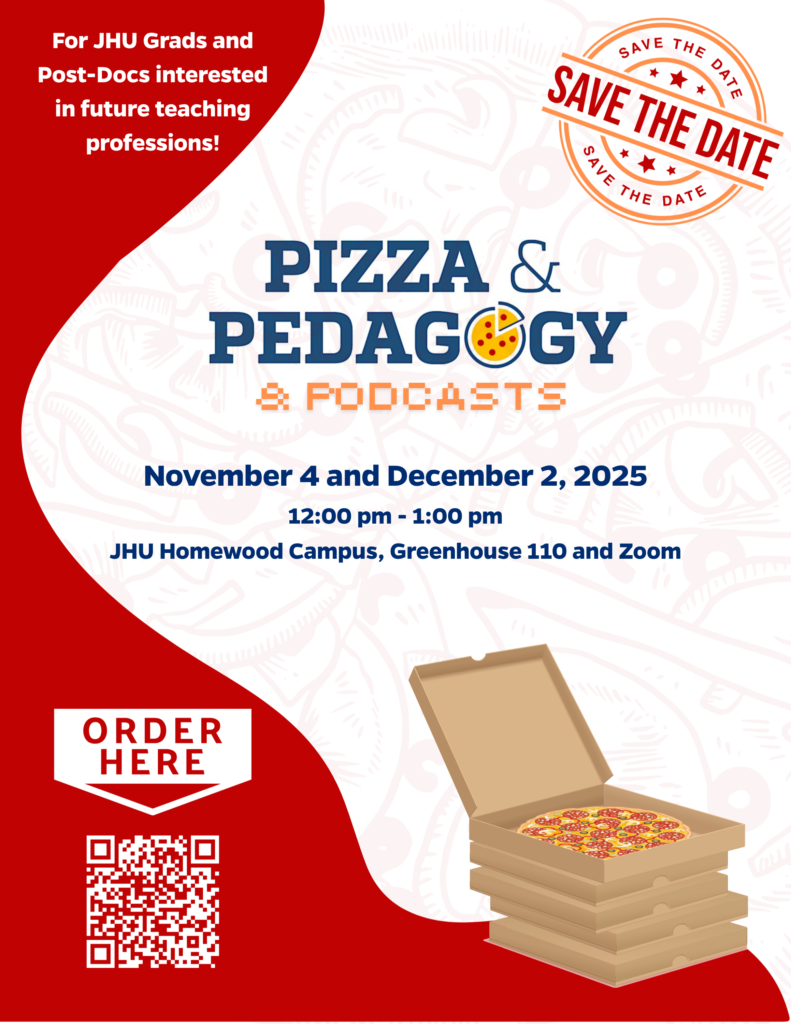
Upcoming Events
Teaching for Transfer and Connection: Applying Mayer’s Insights (Part II)
How can we design instruction that helps learners not just remember information, but comprehend and apply it?
In this discussion-based session, we’ll explore Dr. Richard Mayer’s Cognitive Theory of Multimedia Learning (CTML) and its practical implications for course and media design. Drawing on insights from Mayer’s recent interview on Speaking of Higher Ed, we’ll examine how learning occurs through verbal and visual channels, why managing cognitive load is essential, and how instructional design can foster meaningful learning and transfer. We will also consider Mayer’s newest research extending CTML to include affective, social, and motivational processes—highlighting how emotional design, instructor presence, and learner engagement can contribute to deeper learning.
Pre-work (asynchronous homework)
Listen to Speaking of Higher Ed — “Dr. Richard Mayer: Insights on Revised Bloom’s Taxonomy and Cognitive Theory of Multimedia Learning.” (56 mins)
Before the session, reflect on the following questions that we will explore during the session:
Design for Learning: Mayer describes three goals of multimedia instruction, (1) reducing extraneous processing, (2) managing essential processing, and (3) fostering generative processing.
Which of these do you find most challenging to address in your own teaching or course materials, and why?
Affective and Social Design: Mayer notes that positive emotion, instructor presence, and social connection can enhance learning.
Can you think of a time when the tone or design of a learning experience (yours or someone else’s) affected your motivation or engagement? What made it effective—or not?
Open to JHU affiliates – graduate students, post-doctoral fellows, faculty & staff
Date: Tuesday, December 2nd
Time: Noon-1 PM ET (If in person, please arrive 10 minutes early so that you can get settled and help yourself to pizza before we begin the session at noon.)
Format: 1-hour synchronous workshop (via Zoom or in person with Pizza! Center for Teaching Excellence and Innovation, Greenhouse Conference Room (110), Homewood Campus
Past Events
November 2025
Beyond the Pyramid: Rethinking Bloom’s Taxonomy (Part 1)
Join us for an engaging, discussion-based workshop that challenges traditional interpretations of Bloom’s Taxonomy. Building on Dr. Richard Mayer’s recent Speaking of Higher Ed podcast interview, we’ll explore critiques of the familiar “pyramid” model and consider how learning science—including cognitive theory and multimedia learning—can inform more flexible and inclusive course design. Participants will leave with tools and strategies for crafting meaningful learning objectives and classroom experiences.
October 2024
Episode # 506: “How to Use High Structure Course Design to Heighten Learning”
In this episode of Teaching in Higher Ed, Justin Shaffer discusses the importance of high-structure course design, especially in STEM fields. He explains how well-organized courses—those with clear expectations, pre-class preparation, and active learning—help reduce student confusion and improve learning outcomes. Shaffer also shares his personal experience using these methods, emphasizing the benefits of structured learning for diverse student groups. He highlights strategies such as pre-class assessments and case studies to maintain creativity and engagement within a structured framework.
November 2024
Episode #535: “Interactive Experiences: Shaping the Future of Teaching”
In this episode of Teaching in Higher Ed, Bonni Stachowiak speaks with Andrew Cross and Alyshahn Kara-Virani, co-founders of GooseChase, about designing interactive, experiential learning environments. They reflect on the role of play and storytelling in enhancing learning experiences, contrasting traditional lecture-based teaching with more engaging methods. Cross and Kara-Virani share personal anecdotes highlighting how creating meaningful, playful, and emotionally resonant experiences can significantly improve memory retention and learning outcomes, both inside and outside formal education settings. They discuss the application of the “five E’s” (examination, exploration, explanation, extension, and externalization) to craft meaningful learning experiences. The conversation encourages a playful, adaptive approach to design and emphasizes the importance of curiosity, feedback, and iteration to improve experiences continuously.
December 2024
Episode # 279: Design Thinking in Teaching and Research
In this episode of Teaching in Higher Ed, Bonni Stachowiak interviews Nicola Ulibarri, an assistant professor at UC Irvine, about her journey into design thinking and its impact on research and teaching. Nicola first encountered design thinking during her PhD at Stanford, which sparked her interest in applying it to research productivity. Collaborating with others, she co-founded Creativity in Research, a project aimed at enhancing creativity for researchers through workshops. This initiative led to the development of a book, which emphasizes how design thinking can boost innovation, reduce stress, and foster greater emotional control in research. Nicola and Bonni discuss the role of creativity, imagination, and design thinking in both research and teaching, with a focus on understanding students’ needs and designing solutions that enhance teaching effectiveness.